Peptide Testing: Hplc & Mass Specification Pureness Overview Pinnacle
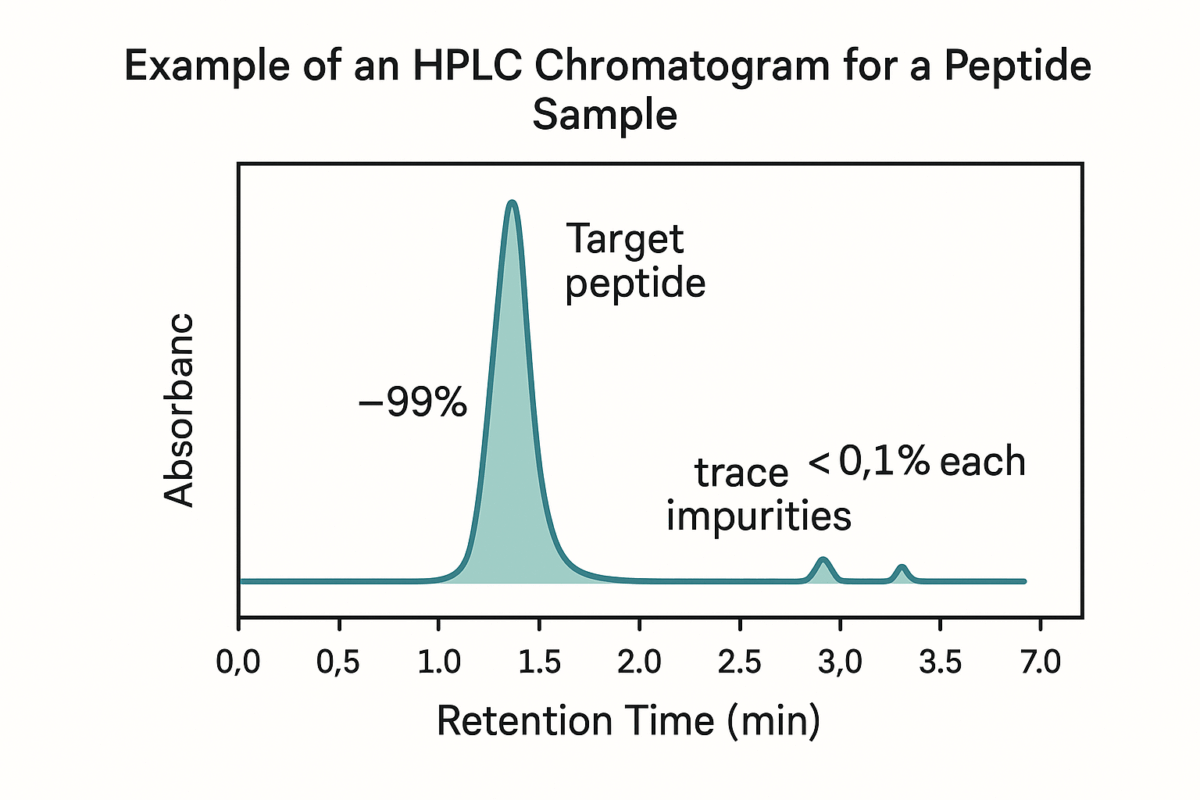
How Hplc Is Utilized To Check Peptide Purity Without independent confirmation, you're relying on advertising cases over clinical proof. And in the peptide globe, that assumption can result in wasted money, fell short research, and potentially major safety problems. You've acquired peptides from what looked like a reliable supplier. The product arrived with a certificate of evaluation revealing 99% pureness. While not shills for "huge pharma", we highly value the massive financial investment they make right into science, quality control, and quality control to decrease these risks for pharmaceutical drug addict. A single HPLC approach can not and will not recognize and quantify everything that remains in a mixture in one pass; it simply does not function that way. Really, no qualitative or quantitative logical approach (LC, MS, FTIR, NIR) can do what individuals regard as the purity result on certificates of evaluation today. However keep in mind, these two optimals do not stand for all possible impurities, excipents, or other chemicals in the product. The pureness is after that quantified as the percent of the primary optimal area versus total locations, giving an accurate procedure of exactly how pure the peptide is [2] Enhancing HPLC, laboratories utilize Mass Spectrometry (commonly combined as LC-MS) to validate the peptide's molecular weight and sequence identification. Mass spectrometry offers molecular verification by discovering the specific mass of the peptide and any kind of co-eluting species or abbreviated sequences with high precision. Together, HPLC and MS data allow analysts to confirm that the peptide's structure matches what it must be (correct amino acid series and expected modifications) which no substantial contaminants exist. Laboratory recognition of peptides is not just a scientific best technique-- it's typically a regulatory demand when peptides are utilized in healing development or clinical study. FDA and the European EMA have actually developed standards mandating extensive analysis and quality control for peptide items to make certain safety and security and effectivenessr.
Introductions Researchers,
Top-tier laboratories often report peptide purity well above 95%, often ≥ 98-99%, by using advanced HPLC and MS evaluations. They likewise evaluate both resources and ended up peptide vials, which aids catch any kind of pollutants, degradation items, or solution disparities. This degree of detailed evaluation ensures the peptide's precision-- suggesting the series and pureness are precisely as labeled-- which is critical for experimental reproducibility. By confirming composition via several validated methods, research laboratory recognition guarantees that researchers obtain a high-purity peptide that will certainly carry out as anticipated in the laboratory. Relied on labs use tried and tested testing protocols to examine peptide examples and verify their purity and chemical structure. A 2016 study released in Nature found that more than 70% of researchers had attempted and failed to recreate an additional scientist's experiments. While peptide purity isn't the only variable, utilizing inadequately defined reagents is an identified contributor to irreproducible results. This is why reliable providers give both HPLC and MS information on their Certifications of Evaluation. As molecules leave the column, they pass through a detector-- normally a UV detector set to 214 or 220 nm, wavelengths where the peptide bond absorbs light strongly. The detector documents just how much UV light is taken in with time, generating a chart called a chromatogram. Pureness is the percentage of publications in the delivery that have every page published appropriately, in the right order, without missing out on phases and no extra web pages packed in.What Is Peptide Pureness And Why Does It Matter In Research-grade Peptides?
What device is used to check peptide purity?
Peptide pureness is consistently established by HPLC (high efficiency fluid chromatography). This method enables splitting up and loved one metrology of each peptide synthesized. If coupled to a mass spectrometer (MS), this supplies molecular mass/ identification information of the target peptide and going along with pollutants.
- For many buyers, logical documentation is a crucial component of vendor choice.
- Underdosed compounds create suboptimal outcomes that lead researchers to desert effective procedures too soon.
- For a 10-residue peptide with 99.5% combining effectiveness, you would certainly anticipate concerning 95% of the end product to be the unabridged sequence before filtration.
- The pureness portion originates from comparing the area of the major top to the total location of all detected peaks.
- Oxidized versions might behave as partial agonists or antagonists.
Certifications Of Evaluation
In concentration-response experiments, these contaminants can shift contours, flatten plateaus, or introduce biphasic behavior that covers real activity of the target substance. Peptides containing methionine or cysteine deposits are at risk to oxidation. Methionine can be oxidized to methionine sulfoxide; cysteine can develop undesirable disulfide bonds or be oxidized to sulfinic or sulfonic acid by-products. These adjustments change the peptide's biological activity and chromatographic profile. Peptides in microspheres and nanoparticles might entangle with matrices, making it hard to divide cost-free and encapsulated kinds. The pump maintains accurate circulation rates, generally in the series of 0.5 to 2.0 mL/min depending upon the method and column style. High pressure requires the mobile phase through firmly packed fragments inside the column, creating sharper separations and higher resolution than typical low-pressure chromatography. At Maxed Out Compounds, we make peptide transparency a top concern. Every product we bring is lab-tested and validated by third-party companions, so scientists recognize precisely what they're dealing with. The most effective nootropic peptides give cognitive advantages just when appropriately produced and verified. These are basic research context observations, not item specifications. Methionine and cysteine deposits can be prone to oxidation. Oxidation changes molecular residential or commercial properties and can change retention behavior, developing distinctive chromatographic heights or Direct Peptides online relevant mass shifts. Asparagine and glutamine residues can undertake deamidation, changing the peptide's charge and hydrophobicity. Deamidation is one factor storage space problems matter, specifically after a peptide has actually been reconstituted. Using a very detoxified peptide lowers these threats and boosts the reliability of your data. However, achieving ultra-high pureness (state 99%) can be practically challenging and may not always be needed, as we'll go over later. The secret is recognizing what level of purity suffices for your needs and just how pureness is determined to begin with.